Spasticity is one of the major impairments impacting motor function and pain in patients following cerebrovascular accidents (i.e., stroke survivors).1 This velocity-dependent resistance to quick stretch has a delayed onset which can occur in as little as one week to three months following vascular lesion.1,2
The mechanism of spasticity remains in question; however it has been correlated to malfunction of the reticulospinal tract and the vestibulospinal tract. These two tracts have an excitatory and inhibitory component that modify posture, locomotion, motor function, and strength.1,3,4,5 Following a vascular lesion, the inhibitory portions of the RST and VST are damaged due to their location near the injury. Ultimately this causes the excitatory portion to go unchecked by facilitating hyperexcitability of the stretch reflex causing spasticity.1
Although centrally mediated, chronic spasticity can create secondary change to peripheral tissues which may contribute to myofascial pain syndromes as a result of compensatory movement patterns.6 Furthermore, chronic spasticity leads to fibrosis of connective tissue and high concentration of collagen fibers that reduces muscle pliability.6,8
Notably, stroke-induced sarcopenia appears to contribute to a rapid decrease in muscle strength; however, the neurophysiologic mechanisms remain unknown compared with non-spastic tissue.7 The hemiparesis commonly seen in stroke survivors also perpetuates further muscle stiffness due to constant activation of the muscle spindle and 1A fibers leading to a lack of contraction release.8 Notably, adaptive changes to the Achilles tendon have been visualized on ultrasound in hemiparetic case studies linked to altered gait mechanics.9 Bone mineral density loss also has been found on the affected side with faster progression in the acute phase following a stroke.10,11
CENTRAL & PERIPHERAL MECHANISMS OF DRY NEEDLING
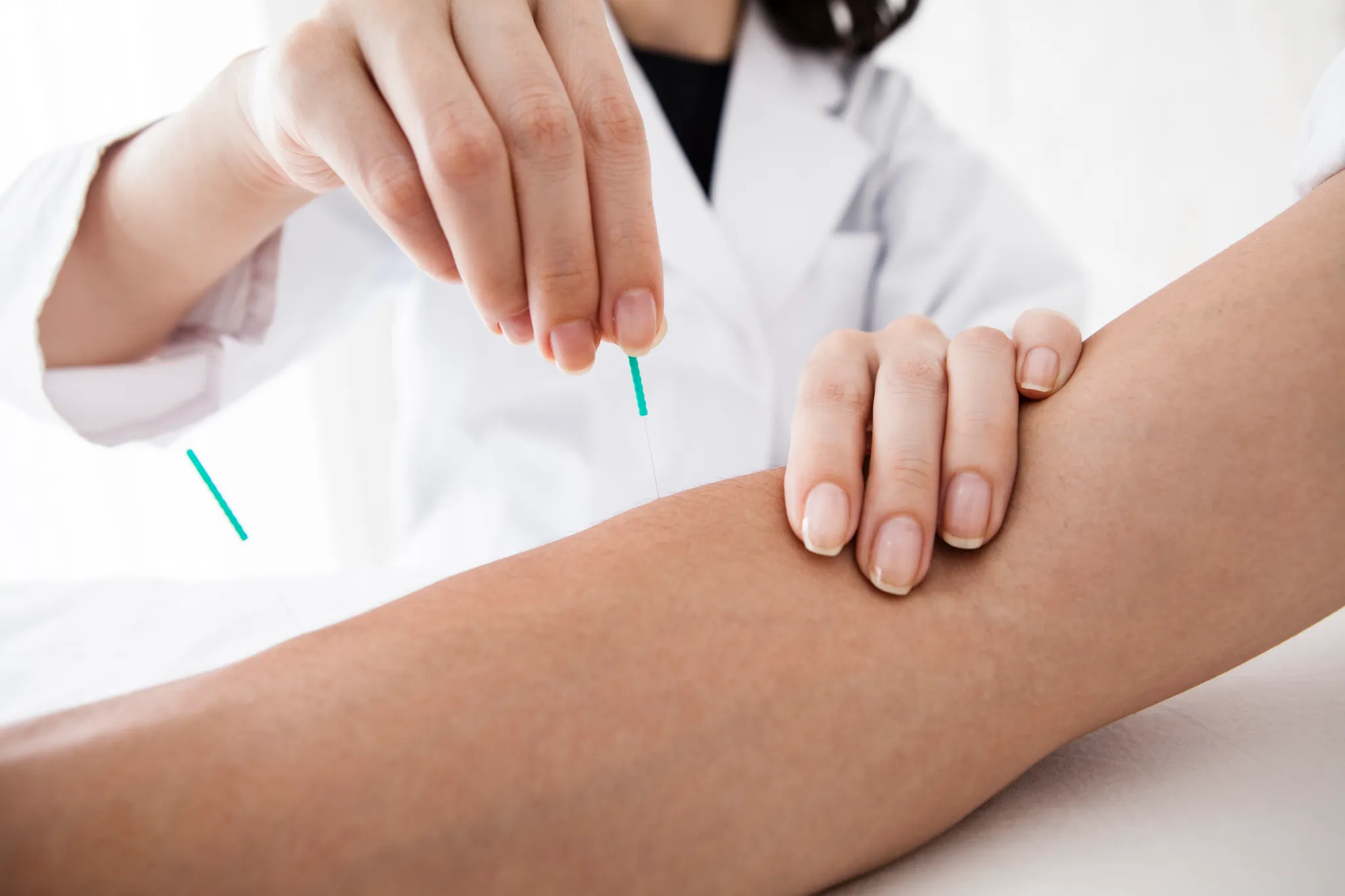
Dry needling can be used to treat myofascial pain syndromes and is not limited to only targeting trigger points; that is, dry needling may also target connective tissues and/or neural structures.12 The central mechanism for analgesia from dry needling likely includes the release of endogenous opioids from the pituitary gland and a decrease in epinephrine and serotonin within the brain, which drives down regulation of pain pathways.13,15
Peripherally, dry needling serves to decrease acetylcholine at the motor end plate, improve vasodilation, and increase sarcomere length.14 Mechanotransduction of the needle, including winding and electrical dry needling, have also been shown to activate fibroblasts to release adenosine triphosphate (ATP).15 Mast cells are also stimulated to release neuropeptides and histamine which contribute to increased release of ATP, local inflammation, and peripheral sensitization.15,27 This high concentration of ATP is quickly broken down into adenosine and can bind to adenosine receptors located in the central and peripheral nervous systems.15,28 Although this pathway is not fully understood, the adenosine pathway does exert an effect on CNS pain modulation.24 Furthermore, dry needling can be used to reduce fibrosis by improving the viscoelastic properties of collagen fibers (i.e., align the collagen matrix) following the mechanical stimulation of the needle along with the aforementioned chemical pathways.15
DRY NEEDLING FOR SPASTICITY
Emerging randomized controlled trials are encouraging for the use of dry needling for short-term improvement in patients with spasticity associated with chronic stroke. Dry needling has been found to reduce spasticity in the short-term (as measured by the Modified Ashworth Scale), improve resting joint position, decrease motor action potentials (via EMG), and improve gait speeds (as measured by the Timed-up-and-Go).16,17,18 In addition, several systematic reviews appear to favor the use of dry needling for management of spasticity and short-term pain relief in stroke survivors.19, 20, 21, 22 Notably, a recent clinical trial reported improvements in muscle spasticity following dry needling in post-stroke survivors.23 In addition, although lower on the evidence hierarchy, several cases studies have found dry needling useful for neurologically mediated spasticity.24,25,26
CONCLUSION
The use of dry needling in the management of spasticity for stroke survivors may include unidirectional needle rotation, bidirectional needle rotation, pistoning, and/or electrical stimulation. Dry needling may reduce the fibrotic nature of spastic tissue in hemiparesis by increasing the viscoelastic properties of muscle and collagen fibers. Moreover, dry needling may increase vasodilation to spastic tissues that are restricted in mobility and movement.
AUTHORS
Marchelle Bostic, DPT, Cert. DN
Fellow-in-Training, AAMT Fellowship in Orthopaedic Manual Physical Therapy
IRG Physical & Hand Therapy, Seattle, WA
James Dunning, PhD, DPT, MSc, FAAOMPT, Dip. Osteopractic
Director, AAMT Fellowship in Orthopaedic Manual Physical Therapy
Montgomery Osteopractic Physical Therapy & Acupuncture, Montgomery, AL
Paul Bliton, DPT, OCS, SCS, FAAOMPT, Dip. Osteopractic
Associate Director, AAMT Fellowship in Orthopaedic Manual Physical Therapy
William S. Middleton Veterans Hospital, Madison, WI
Patrick Gorby, DPT, MPH, FAAOMPT, Dip. Osteopractic
Assistant Director, AAMT Fellowship in Orthopaedic Manual Physical Therapy
Gorby Osteopractic Physiotherapy & Wellness, Colorado Springs, CO
James Escaloni, DPT, OCS, FAAOMPT, Dip. Osteopractic, RMSK
Senior Instructor, AAMT Fellowship in Musculoskeletal Sonography
Senior Instructor, AAMT Fellowship in Orthopaedic Manual Physical Therapy
Wellward Regenerative Medicine, Lexington, KY
Ian Young, DSc, OCS, SCS, Dip Osteopractic, RMSK
Senior Instructor AAMT Fellowship in Musculoskeletal Sonography
Senior Instructor AAMT Fellowship in Orthopaedic Manual Physical Therapy
Tybee Osteopractic & Wellness, Tybee Island, GA
REFERENCES
1. Lis, Sheng. Spasticity, Motor Recovery, and Neural Plasticity after Stroke. Frontiers in Neurology. 2017; 8:120. doi: 10.3389/fneur.2017.00120
2. Sunnerhagen KS, Opheim A, Alt Murphy M. Onset, time course and prediction of spasticity after stroke or traumatic brain injury. Annals of Physical and Rehabilitation Medicine. 2017; 62:431-434.
3. Drew T, Prentice S, Schengen’s B. Cortical and brainstem control of locomotion. Progress in Brain Research. 2004; 143:251-261.
4. Akalu Y, Frazier A, Howatson G, Pearce A, Siddique U, Rostami M, Tallent J, Kidgell D. Identifying the role of the reticulospinal tract for strength and motor recovery: A scoping review of nonhuman and human studies. Physiol Rep. 2023; 11(14): e15765.
5. Atkinson E, Skarabot J, Ansdell P, Goodall S, Howatson G, Thomas K. Does the reticulospinal tract mediate adaptation to resistance training in humans? Journal of Applied Physiology. 2022; 133: 689-696.
6. Stucco A, Stecco C, Raghavan P. Peripheral Mechanisms Contributing to Spasticity and Implications for Treatment. Curr Phys Rehabil Rep. 2014; 2: 121-127.
7. Li W, Yue T, Liu Y. New understanding of the pathogenesis and treatment of stroke-related sarcopenia. Biomedicine and Pharmacotherapy. 2020; 131: 110721.
8. Azzollini V, Dalise S, Chisari C. How Does Stroke Affect Skeletal Muscle? State of the Art and Rehabilitation Perspective. Front Neurol. 2021; 12: 797559.
9. Liang JN, Ho KY. Altered Achilles tendon morphology in individuals with chronic post-stroke hemiparesis: a case report. BMC Med Imaging. 2020; 20:34.
10. Wang T, Sun Y, Guo X, Zhang Z, Liang H, Zhang T. The effect of stroke on the bone mineral density: a systematic review and meta-analysis. The Journal of Nutrition, Health, and Aging. 2024:
11. Kim HW, Kang E, Im S, Ko YJ, Im SA, Lee JI. Prevalence of pre-stroke low bone mineral density and vertebral fracture in first stroke patients. Bone. 2008; 43: 183-186.
12. Dunning J, Butts R, Mourad F, Young I, Flanagan S, Perrault T. Dry needling: a literature review with implication for clinical practice guidelines. Physical Therapy Reviews. 2014; 19(4): 252-265.
13. Chou LW, Kao MJ, Lin JG. Probable Mechanisms of Needling Therapies for Myofascial Pain Control. Evid Based Complement Alternat Med. 2012; 2012.
14. Fernandez-de-Las-Peñas C, Nijs J. Trigger point dry needling for the treatment of myofascial pain syndrome: current perspectives within a pain neuroscience paradigm. J Pain Res. 2019; 12: 1899-1911
15. Butts R, Dunning J, Perrault T, Mourad F, Grubb M. Peripheral and Spinal Mechanisms of Pain and Dry Needling Mediated Analgesia: A Clinical Resource Guide for Health Care Professionals. International Journal of Physical Medicine & Rehabilitation. 2016; 4:2.
16. Zhang Z, Wang W, Song Y, Zhai T, Zhu Y, Jiang L, Li Q, Li K, Feng W. Immediate Effect of Dry Needling at Myofascial Trigger Point on Hand Spasticity in Chronic Post- Stroke Patients: A Multicenter Randomized Controlled Trial. Frontiers in Neurology. 2021; 745618
17. Lu Z, Bailey A, Zhou P, Li S. Are There Trigger Points in the Spastic Muscles? Electromyographical Evidence of Dry Needling Effects on Spastic Finger Flexors in Chronic Stroke. Frontiers in Neurology. 2020; 11(78).
18. Mila ZS, Saornil JV, Chekroun AC, Barragan Casas JM, Llanes RF, Calvino AC, Pascua CL, Sanz DR. Effect of Dry Needling Treatment on Tibial Musculature in Combination with Neurorehabilitation Treatment in Stroke Patients: Randomized Clinical Study. Ist J. Environ. Res. Public Health. 2022; 19: 12302.
19. Fernandez-de-las Peñas C, Perez-Bellmunt A, Llurda-Almuzara L, Plaza-Manzano G, De-la-Llave-Rincon A, Navarro-Santana MJ. Is Dry Needling Effective for the Management of Spasticity and Motor Function in Post-Stroke Patients? A Systematic Review and Meta-Analysis. Pain Medicine. 2020; 22(1): 131-141.
20. de Sire A, Moggio L, Demeco A, Fortunato F, Spanish R, Aiello V, Marietta N, Ammendolia A. Efficacy of rehabilitative techniques in reducing heriplegic shoulder pain in stroke: Systematic review and meta-analysis. Annals of Physical and Rehabilitative Medicine. 2022; 65: 101602.
21. Carusotto AF, Hakim RM, Olivera RG, Piranio A, Coughlan CP, MacDonald TJ. Effects of dry needling on muscle spasticity in adults with neurological disorders: a systematic review. Physical Therapy Reviews. 2021; 26(5): 380-385.
22. Valencia-Chulian R, Heredia-Rico AM, Moral-Munoz JA, Lucena-Anton D, Luque-Moreno C. Dry needling for the management of spasticity, pain, and range of movement in adults after stroke: A systematic review. Complementary Therapies in Medicine. 2020; 52: 102515.
23. Shima Ghannadi, Ardalan Shariat, Noureddin Nakhostin Ansari, Zahra Tavakol, Roshanak Honarpishe, Jan Dommerholt, Pardis Noormohammadpour, Lee Ingle,
The Effect of Dry Needling on Lower Limb Dysfunction in Poststroke Survivors,
Journal of Stroke and Cerebrovascular Diseases, Volume 29, Issue 6, 2020
24. Hadi S, Khadijeh O, Hadian M, Niloofar AY, Olyaei G, Hossein B, Calvo S, Herrero P. The effect of dry needling on spasticity, gait and muscle architecture in patients with chronic stroke: A case series study. Top Stroke Rehabil. 2018 Jul;25(5):326-332. doi: 10.1080/10749357.2018.1460946. Epub 2018 Apr 23. PMID: 29683410.
25. Cruz-Montecinos, C., Núñez-Cortés, R., Bruna-Melo, T., Tapia, C., Becerra, P., Pavez, N., & Pérez-Alenda, S. (2018). Dry needling technique decreases spasticity and improves general functioning in incomplete spinal cord injury: A case report. The Journal of Spinal Cord Medicine, 43(3), 414–418. https://doi.org/10.1080/10790268.2018.1533316
26. Mohammadpour F, Ali Oghabian M, Nakhostin Ansari N, Naghdi S, Dommerholt J. Effects of dry needling on post-stroke brain activity and muscle spasticity of the upper limb: a case report. Acupuncture in Medicine. 2021;39(1):69-71. doi:10.1177/0964528420920294
27. Mai L, Liu Q, Huang F, He H, Fan W. Involvement of Mast Cells in the Pathophysiology os Pain. Frontiers in Cellular Neuroscience. 2021; 15: 665066.
28. Zhou M, Wu J, Chang H, Fang Y, Zhang D, Guo Y. Adenosine signaling mediate pain transmission in the central nervous system. Purinergic Signal. 2023; 19(1): 245-254